

Unionization Efforts among College Athletics
by Tyler Carter
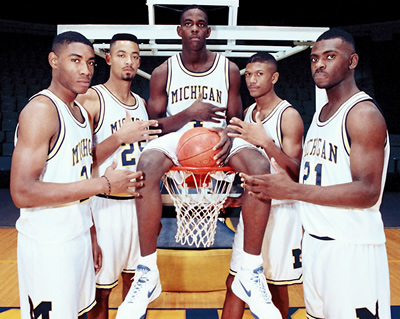 If you think back to the early 90s, and you were a college basketball fan, you will remember two of the best years the University of Michigan’s basketball team ever had. In the recruiting period that spring, five freshmen were recruited and would change the face of that program forever. These five freshmen eventually became to be known by the moniker “The Fab Five.” Every four years, Coach Steve Fisher took his men’s basketball team on a foreign trip to see other parts of the world and it was also a release for the team after such a rigorous season.
The Michigan basketball team as student-athletes were playing against professional teams to expose them to new experiences and to gain practice time before the season began. In the 2011 Fab Five documentary, player Jalen Rose said he noticed that the gym was full and realized someone was getting paid for their being at the venue but no players were being paid. Nike sold shirts with their likenesses, branded shoes as “Fab Five Nike’s”, and produced other Michigan paraphernalia with their likenesses. Today universities are more advanced in marketing than they were in the ‘90s’. Money from alumni helped pay for coaches with million dollar salaries, but the players still get no pay and benefits.
 Now, they want a piece of the pie. Former Northwestern Football player and quarterback Kain Colter and other entities are trying to change the landscape of college athletics by trying to form a union as a solution for college athletes.
Colter and Ramogi Huma, president of the College Athletes Players Association, petitioned and won a decision by the Chicago office of the National Labor Relations Board that football players at Northwestern qualify as employees under the definition established by federal labor law. If upheld in court, this would ensure players health and safety protections such as medical coverage for injuries, like brain trauma and raise the amount of money that athletic scholarships provide. While athletes are simply looking to get a seat at the table, the National Collegiate Athletic Association is fighting the ruling along with Northwestern University. In talking with former student-athletes who participated in Division I athletics, I wanted to obtain their thoughts and opinions about the current whirlwind going on in intercollegiate athletics and the possibility of reforming a system where change is desperately needed. Current Ole Miss athletes contacted about this issue offered no response.
Jason Cook, a four-year starter and fullback at the University of Mississippi from 2005 to 2008, graduated with a bachelor’s degree in English with a minor in political science. He got his master’s in African-American studies. Jason appreciates the work Kain Colter has done in trying to reshape college athletics.
“I greatly admire the efforts of the Northwestern Football players. I believe that they recognized the exploitation of the NCAA and their university and set out to take action.”
Scottie Haralson a former Mr. Basketball from Mississippi signed with the University of Connecticut Huskies out of Provine High School in 2008. After one year, Haralson transferred to the University of Tulsa to complete his educational and athletic career. Haralson, who plays with the Canadian Basketball League Brampton A’s said the move toward unionization in intercollegiate athletics is long overdue.
“I think that Northwestern is doing exactly what should've been done a while ago. Not surprised it hasn't happened sooner. Players are basically working for the university and not getting rewarded for the amount of revenue they are bringing in to the university.”
Last month, the NCAA made $770 million in television revenue from its annual men’s basketball tournament. NCAA member schools will keep all of this money for themselves. The student-athletes will be paid nothing. If college athletes were allowed to unionize, men’s college basketball players could reasonably expect to earn several hundred thousand dollars for playing in the NCAA men’s basketball tournament. The NCAA has petitioned the National Labor Relations Board to deny student-athletes’ right to unionize.
Cook said he thought student-athletes should be paid.
“While my education was paid for, and I am greatly appreciative of it, I believe that the services rendered unto the university are greater than the compensation. This is definitely the case for the high revenue sports. As a former student-athlete, no other student on campus is asked to do what the student-athlete does on a daily basis (practice, film, work outs, study hall, community service, etc.). One caveat that would prevent student athletes from being paid would be the amateurism debate.” Haralson feels that student athletes should be paid.
“The high profile sports bring in so much revenue to the schools that we should see some of the money. Although I understand why NCAA doesn't pay college athletes because it takes away from the amateurism of the athletes. Once they get paid, they are pros and not amateurs anymore.”
In the 2013 documentary, Schooled: The Price of College Sports, by Trevor Martin and Ross Finkel, former UCLA running back Jonathan Franklin describes his every day schedule. He awakes at 5:30 in the morning and is at the weight room from 6 to 9. He’s in class from 10 to 1 p.m., and at meetings from 2 to 3:15, and at practice from 4 to 6. Next comes tutoring and homework. He wakes up the next morning and does it all again the next day.
“Definitely an employee considering everything we are responsible to do,” Haralson said. “Classes, tutors, meetings, practices, travel, games, et cetera, add up. Time management is important because we’re putting in longer hours than most people who work just a 9 to 5 every day.”
The term student-athlete was created by Walter Byers, the first executive director of the NCAA. He served as executive director for 37 years. Byers wrote a book entitled, “Unsportsmanlike Conduct: Exploiting College” where he talked about the exploitation of college athletes and the purpose behind the term, student-athlete. In his book, he said the term was to give the NCAA leverage against athletes who obtain injuries and seek workers’ compensation all while making money for the school. Furthermore, it implies that athletes are students first, but are working at their professional training as a student and are therefore not subject to workers’ compensation. The most prominent case that establishes that a student-athlete is not an employee is Waldrep v. Texas Employers Insurance Association. Kent Waldrep was a Texas Christian University running back who was paralyzed from the chest down in a 1974 game against Alabama. Because of the injuries he suffered, Waldrep filed for workers’ compensation in Texas in 1991. A compensation commission ruled in favor of Waldrep, only to have that ruling overturned by a district court jury.
In affirming the jury's decision, a state appeals court listed all the ways in which Waldrep did not qualify as a university employee. Among them: the letter of intent and financial aid paperwork signed by Waldrep and TCU did not constitute an employment contract. Financial aid did not represent income. TCU did not pay or promise a salary, did not withhold taxes, and did not tell Waldrep he was or would become an employee.
UConn point guard Shabazz Napier recently told CNN the day before the National Championship game against Kentucky that he sometimes goes to bed hungry and has hungry nights. Cook and Haralson said they both did too.
“Absolutely.” “Very rarely are there athletes, and regular college students for that matter, that have not endured such pangs. When I played, you received a scholarship check every month. Once rent and bills were paid, there was a remaining balance of around $150 to $200 to use as discretionary income. This was insufficient and wholly inadequate.”
“Yes I did,” Haralson said. “Some nights you had to snack on something and just hit the cafe early that next morning. Doing all we could to stretch that dollar out.”
Matt Ball, the senior associate athletics director for compliance at the University of Mississippi, said that student-athletes should not be paid.
“There are too many barriers to pay student-athletes,” said Ball. “From federal regulations regarding Title IX, to determining do you pay a walk-on kicker who never sees the field the same as you would pay a running back that rushes for over 2,000 yards? How much does a softball player make? Do they get paid the same as a football player? I don’t think they should be paid, but I do think they should be better taken care of and the new meal legislation passed by the NCAA should help with that.”
Napier’s comments on going to bed some nights hungry prompted the NCAA the very next day to enact a new meal legislation that allowed unlimited meals for the student-athletes.
On April 30th, the Northwestern football team voted whether to unionize or keep their current system. It may be a while until the general public knows the results from the votes, but the verdict is still out on whether unionization is a good move for the athletes.
“The cons would be becoming an employee in unionizing and that means you can be taxed on everything owed to you,” Ball said. “Outside of the revenue generated sports, it can create a large rift between the two and can negatively affect their opportunities and ability to continue to exist.”
Cook thinks the NCAA can do more to help student-athletes. “I think the NCAA affords the scholarship athlete great opportunities. But as mentioned before, the services rendered are not congruent with the compensation currently being received. I believe that there is one main thing that would better serve student athletes. There must be a more stringent adherence to the 20-hour rule. Many athletes are working upwards of 30-40 hours a week and beyond.”
The 20-hour rule according to the NCAA states during the season or designated training periods, such as spring football or fall baseball, athletes are limited to 20 hours of countable activity per week and must be given at least one day off. However, travel days can count as a day off if no other activities are planned. The rest of the offseason, athletes are limited to eight hours per week and must be given two days off.
Cook has an interesting perspective on future endeavors by the NCAA.
“I do not believe that anyone has the capacious foresight needed to say that unionization will change the landscape completely,” Cook said. “I do believe, at the very least, that it will send a message to the NCAA that athletes have a voice and will exercise it. Furthermore, the unionization of players speaks truth to power and has exposed the wide exploitation of athletes by those with heavy fiduciary stakes. Should the unionization happen, I believe it will be initially confined to private universities within the NCAA. Employee status there would mean a great deal. We may never see the unionization of the major public BCS universities simply because there is too much money at stake.”
Haralson expects danger as a result of the current attempt to unionize at Northwestern University. “I think it will be completely different 10 years from now considering rules change very year. Other sports and teams will form unions as the years go by. Puts pressure on the NCAA.”
Ball hopes that college athletics can continue union-free, but be geared more toward helping and accommodating the needs of the student-athlete. Preparing them for life after college, money management, and just preparing them to be self-sufficient members of society.
Whatever decision made, they must agree it is time for the NCAA to make more changes in its treatment of student athletes.
About Tyler Carter
Tyler Carter is a first-year graduate student from Jackson, Mississippi pursuing a master’s degree in journalism at the University of Mississippi.