

No Audiences? More Audiences?
A Hand is Pushing the Distance Education Growing
by Chun Wu
Charles Mitchell is sitting in his arm chair talking to his computer by himself for 20 minutes. 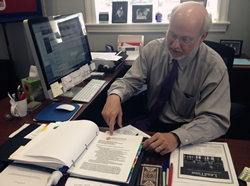
“On page 45, you see it’s a blah blah blah…” he puts his finger on the mouse to pause the recorder, takes off the special microphone, pushes away his notebook. He stands up and stretches with his arms, tilts his head to look through the door at other faculty in the office, slowly sits down with a sigh. He presses the start button, and continues to talk to his computer, once again.
This has been going on for almost two weeks.
Charles Mitchell is an assistant dean of the Meek School of Journalism and New Media at the University of Mississippi. This spring semester in 2014, he is teaching an online section of Journalism 371 Communications Law. He records his lecture and prepares slides in advance and uploads it on Blackboard, an online system that consolidates critical information for Ole Miss student courses, so that students can listen and study the class whenever and wherever they want to.
Does Mitchell enjoy it?
“Would you like sitting in this chair talking to that wall?”
You can tell from his expression that it was not a smart question.
Mitchell has a different attitude when he teaches another section of the same Journalism 371 class in the classroom.
It’s Tuesday morning at the auditorium room in Farley Hall and Mitchell is wandering slowly onto the stage in front of 167 students. He pulls out his “wand” with the toy finger on top and points to a student. 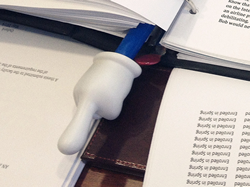
“What kind of machine makes the photo copy?”
“Xerox,” several students answer.
“Right, that’s the trademark name.” Mitchell says and takes his wand back. Then he walks to the other side of the classroom and continue his lecture. The wand is just one of interested way he engage studetns. The give-and-take in classroom lecture is important, nothing mining from the online classes.
Mitchell has been teaching for two years.
“It’s like an actor with no audiences.” he says. “When you live teach, you can move around, you can call on people, you can also see people’s faces whether they look confused, whether they are nodding, but you cannot do that online. That makes it more challenging because you don’t really get a sense except on the test whether the student understands what you saying.”
Online teaching is not something new at the Meek School. Eight professors are teaching online journalism or Integrated Marketing Communications (IMC) classes. In total, eight schools at Ole Miss are providing online classes. The history of online education here dates back to 2001.
“It actually started as a push by the director and the dean to continue education and as a way to service students who are at the regional campuses, such as Tupelo and Southheaven campus,” says Anne Klingen, director of Department of Online Design and eLearning.
Online classes are just one of three types of distance education. The others are: independent study, where classes are taken by an individual with little to no supervision; and the compressed video class, which allows students at regional campuses to interact live with students at the classrooms on main campus along with the Instructor via television. Online classes, also called E-learning, refer to classes that are accessed via the web.
Back in ‘80s and ‘90s, Ole Miss professors had to get on the bus to be driven one hour to Tupelo or Southheaven-mostly at night-to teach students in those regional campuses, then come with hour’s ride back to Oxford. The dramatic growth of students in those campus brought huge pressure as well as the need to expand offerings during the day and to more students. This is when compressed video emerged.
Compressed video class relied on network quality where times was poor “We noticed the idea of online class through Internet and many other universities are using it, so we decided that it would be a way of offering classes to the regional students.” Klingen says.
She was shocked in 2004 when the university moved to the new system called the SAP and MY OLEMISS, which opened enrollment of online classes to every student. “95percent of those classes were signed up by the Oxford main campus students,” Klingen says. “We’ve never considered the students taking classes on Oxford would prefer to taking it online as opposed to with a professor live.”
Even today, the majority of online class students are Oxford students.
Tiffany Odom, an Integrated Marketing Communication senior studying at the Ole Miss Oxford campus, has enrolled inMathematics 115 Elementary Statistics online class, which doesn’t have any lecture but a weekly study guide and quiz.
“I really hate math,” Odom says, “I chose to take it online, basically so I didn't have to sit through an hour and a half class that I hate.”
On a typical Sunday, she wakes up in the morning and, instead of hurrying to put on make-up and fixing her hairs and dressing up, she serves herself some breakfast and then comfortably sits on her favorite spot to work on the online posted study guide for Math 115. A quiz of 20 to 30 questions is due at 11:59 pm that night.
Odom prefers the online math class rather to the live classroom class. “I am the kind of person who likes to figure things out for myself. I get really confused in the midst of listening to the teacher talk, to other students, what the person in front of me is wearing, why the person behind me won't stop tapping her pen, what I could be eating for dinner, the rest of my classes... It is nice to just be alone working on my homework.”
Odom sees benefits in time management with the online class “I am getting to work on the class during my own time. I feel I have more control and I can go at my own pace.”
Her Google calendar has already run out of blank space. “An internship at law school, radio show, Ole Miss Marking Agency(student organization) and 18 credit hours of my class, these are taking over my life.” Odom says.
It seems that as a student, Odom’s priority is not just study. On the contrary, she is cutting down her study time for something else which is more important to her.
Luan Vu, a senior with a double major in International studies and the Chinese flagship program, and a minor of business, is having a tight semester too. “ I take Geology 101 Physical Geology online because I think this class would be easy and I don’t want to waste 150 minutes of total three times every week to go to the lecture and the classroom when I could just use 40 minutes to read the study guide and 5 minutes to do the quiz. Rather, I can put more efforts and time to work on my ‘weed out’ class, Accountancy 303 Financial Accounting and my other school projects and activities."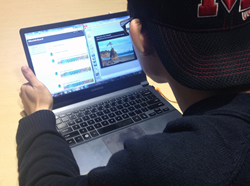
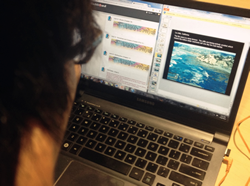
Odom and Vu are considered as non-traditional students. According to the Ole Miss website, non-traditional students are students who are above the age of 25, students who are married, students who are financially independent, students returning to school after at least a three-year absence, students who are veterans, students working either full- or part-time, and transfer students.
A fact about the University of Mississippi is that non-tradition students like Odom and Vu has being grown from 10.8 percent of the enrollment in 2009 to 12.8 percent in 2010.
In other words, students tend to have jobs or other obligations beyond study. These are the students most likely to register for distance education.
Klingen says online class students mostly access blackboard on lunch time or around midnight.
“The traditional 8 a.m. to 5 p.m. class time period is not what students are studying today. School is not on students’ top priority list, not even close to Number three sometimes. These students are trying to maximize their time and online class will help them do that.”
Klingen also points out that economic pressure and community pressure push students to choose online class. “For me right now, I have what they called the top, and the bottom pressure, where your parents are getting older and you have to live in a certain state with them. A move would cause so much change of my personal dynamic that I don’t want to do that. In this situation, only either an online class or a very low residency might work.”
The Ole Miss student population has been increasing record for 19 straight years. In 2013 fall, a 3.5 percent overall enrollment increase broke the former record while college enrollments nationwide are generally declining.
The campus is trying to keep up with the increasing population through different ways. “Online class is also a way to ease the problem of lack of classrooms and parking spots.” Klingen says.
However, does compressing 150 hours per week’s study into a study guide and a 10-question quiz affect quality? Mitchell don’t know.
“Sometime I will give the exactly same test online as I give in the live class, not always, but sometimes. Just to test to see how it matches up,” Mitchell says, pulling out the mean and the medium score and the range of the comparison. They are almost identical.
Mitchel sees the advantage of distance education but he believes a skill-base class should be taught in the classroom.
“I don’t want anybody flying an airplane I’m on who has only flown on the computer. I want them to actually have flown in a real plane before I get on it, please.”
Regardless of subjects and contents, Klingen believes that as long as she can observe and learn how the professor interacts with students in the class and know the learning objectives, she can recommend the best plan to teach online.
“What I envision is to be the problem with an online course in anatomy,” says Dr. Christopher Leary, an Assistant Professor of Biology. “I understand you can do it online, that this does this, this is part of this, and this is muscle tissue while that is brain tissue. But, when it comes down to actually performing, you know, dissections. That’s what I am saying, how could you possibly do that online.”
Dr. John Holleman, who teaches EDRS 605 Educational Research, says some of the for-profit online universities aggressively marketing their programs but followed up with lower quality, no connection or interaction and tedious slides and class design has gender a certain stereotype.
Biology 104-Inquiry into Life teacher, Dr. Wendy Garrison enjoys online teaching. Garrison feels that she gets to know the students better through online classes.
“When students are in the class, they are just there. I just see them. I see their face but I don’t know what they are thinking, where they are came from, what their goals are or what their personalities are.”
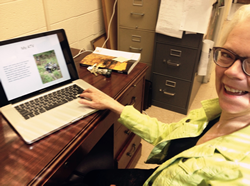 It will take more than 2 classes to ask a class of more 100 students to introduce themselves. But a professor you can ask students in online class to introduce themselves simply by summiting word documents to blackboard. “I feel like I know who they are more by the assignment, by the emails they send me, by the questions they ask and the way they ask questions, but mostly by the introduction they do and how thrilled they are on the regular assignment.”
Most students think it’s easier to get A with online classes. In fact, it’s easier to study and understand key points as opposed to traditional live lectures that depend on books and slides.
In his online class, John Holleman usually sits in his office and uses a software called Adobe Connect. Students can see him lecture and view slides. When a student named Martina “raises her hand” for question- indicated by a flashing icon on the screen.. Holleman turns her microphone on so that they can communicate. Others can join in too. 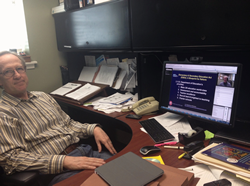
As a clinical assistant professor of higher education and program coordinator, Holleman enjoys teaching higher-level online classes and believes that online education will grow dramatically. The major beneficiaries will be older students.
“I think the whole idea of lifelong learning is become much more important. I feel very strongly that when we finished our degree whether it is bachelor’s degree or master’s degree, learning has to continue. “
Holleman believes the non-traditional student is attracted by the online classes because he/she has work, a family, and many other concerns.
Holleman says: “But for the young adult, the 18to the 22-year-old students, I think the traditional university like Ole Miss will continue to play such an important role.”
As for Professor Mitchell’s next online lecture, he jokes: “I’m not going to talk with my computer again till the beginning of next semester.” Still, he believes more and more students will choose online courses, whether the reason is society pressure, economic pressure or convenience.
About Chun Wu

Chun Wu is a second-year graduate student from Guangdong, China, majoring in Journalism with an emphasis in Integrated Marketing Communication at the University of Mississippi. You can email her at cwu1@go.olemiss.edu