

Are Mississippi Community Colleges Preparing Students for the Future?
by Ed Connolly
 When you watch NBC T.V.’s hit comedy, “Community” do you come away with an idea of community college as sort of a faux-college, or maybe high school II.
Perhaps you already formed such an opinion long ago.
If that is the case, maybe some of the following will surprise you.
Here is a short list of some noteworthy Americans who have attended community college:
Eileen Collins, former NASA astronaut
Arthur Goldberg, Supreme Court Justice
Jeanne Kirkpatrick, former United Nations ambassador
Maxwell Taylor, former chairman of the Joint Chiefs of Staff
George Lucas, Hollywood movie director of Star Wars
Perhaps it would surprise you that, according to the National Science Foundation – National Center for Science and Engineering Statistics, “The percentage of science, engineering and health (SHE) graduateswho had … attended community college … remained steady, at around 50 percent for bachelor’s degree recipients and just under 45 percent for masters degree recipients”.
According to Community College Week (from U.S. Dept. of Educations data), in 2007-2008 83 percent of academic degrees conferred in the Unites States were associate degrees, with bachelors and masters degrees combined making up less than 10 percent of the total. The rate of growth in associate degrees is growing at more than 3 percent annually; and the total associate degrees awarded grew by just under 35 percent in the 10 years between 1998 and 2008.
And this just relates to students who achieve associate degrees and does not include trends on students who transfer to four year colleges after community college without associate degrees.
These kinds of statistics show the importance of community colleges to society and to the national work force. The fact of the matter is they are continually becoming more important.
President Obama’s “American Graduation Initiative: Stronger American Skills Through Community Colleges” in 2009 detailed the need for community college education as part of the overall higher education system in America. The president’s plan includes new funding for community college infrastructure improvements and modernization of academic facilities such as laboratories. A major part of the initiative involves student aid funding, with increases in Pell Grant scholarships and other aid programs. The focus is on health sciences, engineering and mathematics. With this initiative “President Obama declared that “by 2020 America will once again have the highest proportion of college graduates in the world … .”
Given this increased emphasis on the importance of community colleges, it is important to know how well prepared and successful former Mississippi community college attendees have been after transferring to a four year college. Three students – Rebecca (Becky) Newman, Trey Powell and Haley Sims – all of whom are now attending the University of Mississippi - provided some insight by sharing their personal stories and their critiques of their community college experiences.
These students have diverse backgrounds in terms of their home life before college, their choice of community college, their intentions and objectives on entering community college, and their reasons for choosing Ole Miss as their four year college. Their varied family experiences had a lot to do with their choices for education after high school. Entering a four year college directly after high school was not a realistic option for any of them.
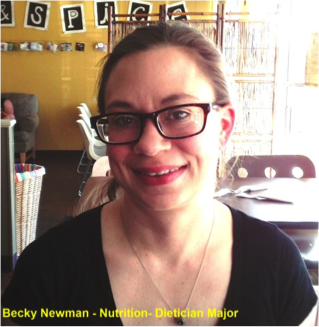 Rebecca Newman is an example of a self-motivated, tenacious, goal driven student.
Newman is a transfer student from Tupelo who attended Itawamba Community College in Tupelo. Her major at Ole Miss is in the health science discipline of nutrition. “Becky” describes herself as “very much a nontraditional student.” She is married with three children, lives in campus married student housing, and took all of 10 years, 2003 – 2013, to accumulate sufficient transfer credits and financial aid to make the transfer to Ole Miss. She estimates that she had been attending college either full time or part time eighty percent of the time in that 10 year span; “I worked full time and was a full time student with a family.” Newman intentionally did not take her Associate degree because she found out that accepting a terminal degree would limit her financial aid opportunities when she transferred to a four year college. She entered Ole Miss as a full junior in 2013.
Trey Powell is a civil engineering major at Ole Miss. He, like Becky Newman he extended his community college time in order to accumulate sufficient credits for transfer to the four year institution. Trey is from Pasgagula, Mississippi and he attended Mississippi Gulf Coast Community College.
“Initially, I did not want to pursue a college education” Powell said. His dad and family friends worked in the petroleum industry, and he recalled thinking that jobs were plentiful in his home town. Powell figured all he needed was an associate degree in petroleum technology to secure a good-paying job with a promising future. But Powell’s sister was attending Ole Miss while he was in college at Gulf Coast.
Visiting his sister at Ole Miss in Oxford had an influence on him, and her advocacy for continuing his education when she returned home between semesters got him interested in pursuing a four-year degree.
Once persuaded Powell had to add numerous classes to put himself in position to transfer. In reflection he said “I would not have obtained my Associate’s Degree. If possible, I would have chosen to only take courses that would transfer for my bachelors of science in civil engineering.” He did obtain his degree at Gulf Coast but had to attend for an additional year in order to accumulate enough credits for acceptance as a civil engineering major at Ole Miss. As it was he was accepted as a sophomore until he caught up to the students who had entered as freshmen. After completing his schooling at Gulf Coast, he had accumulated nearly one-third more credits than he needed for his petroleum technology Degree.
Haley Sims is also a civil engineering major. She is from Ridgeland Mississippi, and attended Holmes Community College in Goodman, about 60 miles north of Jackson.
“[I chose civil engineering] because I originally wanted to become an architect. However I quickly learned that it is the engineer’s job to build and make things work. I love the challenge of figuring out a difficult math problem, or how to make something work properly”.
Unlike the other students, Sims primary motivation for her college choice came from the desire to play her favorite sport and opportunities for a sports scholarship. “I wanted to study engineering and I also wanted to play fast-pitch softball for at least one year in college to see if it was something I wanted to
continue… . Out of high school the only scholarship offers I received to play softball were at Mississippi College and Delta State. Neither of those schools fit my personal preference. So instead, I decided to play ball at the community college level first and then decide from there if I wanted to continue to play at the university level. Holmes Community College was close to my hometown and they have the pre-engineering program. I tried out for the fast-pitch softball team at Holmes and made it, and after touring the school, I really liked it. So, I packed my bags and headed to Goodman, Mississippi.”
She added, “I am also independent of my parents, financially speaking, so I wanted to find a school where everything would be paid for and I wouldn’t have to take out a loan, which was another reason Holmes CC was the best choice for me”.
Without the community college option neither Newman nor Powell would be in a position to achieve a bachelor’s degree, and all are planning on going beyond that to obtain masters and, in Sims’ case, a doctoral degree. The three are highly competitive on grade performance with students that had entered as freshmen.
At Ole Miss Newman, Powell and Sims were able to find scholarships and work study to help them manage their finances. Several of the scholarships were exclusively for students who transfer from community colleges. Some were U.M. based scholarships, and others were community-of-origin based. Newman said the university worked closely with her to search for scholarships that might be available to her. From these accounts it would seem that the University of Mississippi has made a real commitment to making college affordable for transfer students. Sims related that she was actually recruited by the university while at community college. Mississippi State may be the logical first choice for engineering and technology inclined students, but U.M. appears to be reaching out to attract more in-state students and to boost their program awareness.
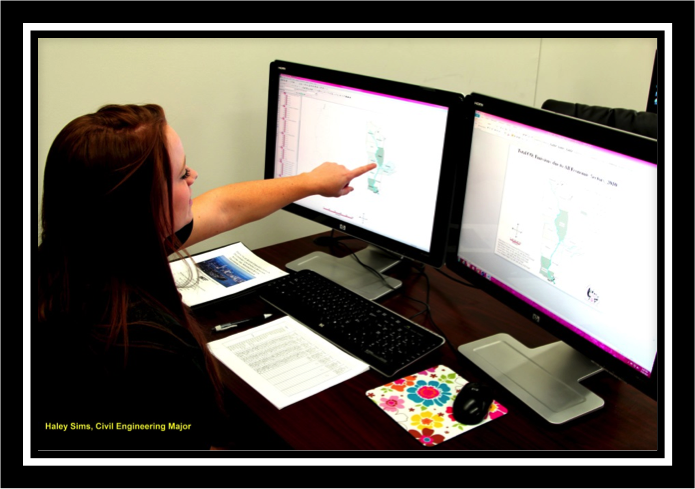
Having the opportunity to participate in a work-study program is a key factor in making four-year college a reality for transfer students. It not only provides important financial support, but it is also supportive of their major field of study. Sims and Powell work at the Civil Engineering Labs on real-life projects for external clients that are directly related to their engineering discipline. Sims is engaged in an engineering feasibility study for resurrecting an old abandoned rail line to provide a new passenger service that would alleviate traffic on heavily traveled highways. Powell is working on a similar project at the C.E. Lab and Newman is applying for the Graduate Coordinated Program which allows her to work in her specialty while pursuing her masters degree.
It is clear from the stories of these three transfer students that motivated and self-directed students can do well and be successful at both community college and in demanding major fields of study at a four year university. But what about the community colleges themselves?
A key function and responsibility of the community college is to provide guidance and advisement to students on course selection and scheduling tailored to the students’ objectives and timelines. This is essential to keep students motivated, on plan, and on schedule. But this may be a significant area of failure contributing to a high rate of student drop-outs.
Certainly this was the experience for Becky Newman, who wasted a lot of time meandering through schedules and course offerings that were either not appropriate to her academic objectives, were sequentially illogical, or did not earn her credits that were transferrable. At Itawamba she said "It was stressful. I felt like I was on my own when it came to picking courses for my major which would transfer." In fact, she had to depend on Ole Miss representatives on visits to her campus to sit down and review with her what courses she needed for transfer and which ones she had taken would not be accepted.
Sims and Powell had a different experience. Both were satisfied with their community college counseling and advisement functions. So even among three Mississippi community colleges there appears to be a great deal of variability on how well the community colleges meet student needs in critical advisement and scheduling areas. There is clearly a need for improvement.
Nationally a number of states and community colleges have established “benchmarking” models for improvement, improvement measurement, and strategic planning to meet the Presidents Graduation Initiative and their own regional needs. A good example of a state guidance plan is: Metrics, Dollars, and Systems Change – Washington [state] Student Achievement Initiative as a Model for Other States. At the community college planning level is Cleveland’s Cuyahoga Community College Strategic Plan for 2009-2014, Where the Future Begins. These two are best practices models for states and local community colleges but are only two among many valid, published planning strategy documents.
With these models as a frame of reference, how well are Mississippi community colleges measuring up in comparison?
Pearl River Community College is ranked highest in Mississippi on CollegeMeasure.org national ranking of community colleges and can provide a good standard of measurement for how well leading community colleges in the State of Mississippi are planning for the future and for meeting the President’s community college education initiative. Dr. Rebecca Askew, Vice President for Planning and Institutional Research, says that PRCC measures itself primarily against state, national accreditation and regional community college association criteria (standards setting bodies). But when it comes to strategic planning and “performance measurent” for improvement, even this high performing Mississippi institution falls short. According to Dr. Askew, PRCC continues to use an upper level management, complicated and dissociated performance measurement system that is useable only by high level administrators instead of one that can be used as a tool for the entire organization, including students.
This example does not bode well for Mississippi, and the future for other students like Neman, Sims and Powell may be in jeopardy. If the highest ranked community college in the state is not utilizing the best available technology to meet the demands of the 21st Century, then the state risks falling behind. Advancements and progress in community college programs need to be both state led, and local college initiated and developed.
For a state that desires to both attract new industry from outside the state and grow its own industry; a state that wants to develop its transportation and infrastructure systems for the future; a state that wants to grow and improve the quality of its communities, it must want to lead. Mississippi could be in the forefront of community college advancement to meet the challenges outlined in the president’s American Graduation Initiative, but it risks being left behind by being a follower instead of a leader.
In the final analysis, community college is serious business. So next time you are watching NBC’s hilarious sitcom “Community”, have a good laugh; but remember that for the future of Mississippi and America, community college is everyone’s business. Will Mississippi learn to be a leader in higher education in the 21st century, or will it be content to be a follower. A real opportunity exists by getting on board with the Presidents American Graduation Initiative. The future starts now.
About Ed Connolly
Ed Connolly graduated from Hudson Valley Community college and received two A.A.S degrees, one in accounting and the 2nd in Mechanical Engineering Technology. Known in the engineering field as a "mustanger" Ed worked as a metallurgist, then an engineer for 20 years, and finally as a Quality Assurance Manager in FDA regulated industries. Ed retired in 2011 and decided to begin a second career as a freelance writer of nonfiction intended for magazine and newspaper publication. He lives with his wife Lyn in the Adirondack Mountains of New York not far from Saratoga Springs. In the winter months they live in Oxford where both study at the University of Mississippi.